About a year and a half ago, I began to discern what my path after graduating from college would look like. During the fall of my senior year, I spent as much time crafting supplement essays and asking professors for recommendations as I did on my academics. I was set on keeping all of my options open–Fulbright, Princeton in Latin America, JVC, JVI, Peace Corps, the list goes on! I was so full of hope and excitement at the opportunity to finally put what I had learned over the past four years into practice in the “real world,” at the chance to live out the values that I had absorbed from my education, that I became anxious in my discernment. How would I know which path was “right?”
This concern, while legitimate, was undergirded by a larger one: What if I failed to become the person who I aspired to be? What if my life was ordinary and uninspired, a story inconsequential to the injustices that I cared about? Despite being acutely aware of my small place in the universe and my many flaws, I will be the first to admit that whatever I possess in humility I match with ego; I am conscious of my gifts and want to do them justice. I am afraid of wasting all of the opportunities that I have been given, and equally, of letting down the people in my life who seem to have confidence in my dreams and abilities even when I struggle to see them. I also fear disappointing my determined and hope-filled (idealistic?) college self, failing to live the answers to the questions that circled in my head during seminar discussions, late-night community organizing meetings, immersion trips, and retreats. I promised her that I would not forget everything that she learned and experienced. I am afraid of forgetting.
In other words, the question of what to “do” after graduation was made heavier by the fact that it often felt not so much like a decision to be made as a diagnosis of what I was to become (spoiler for all the seniors out there: this is untrue).
Flash forward a year. November 2018. So much happened in the time in between, notably, that I graduated from college and had discerned that I would pursue two years of service as an environmental education volunteer with the Peace Corps in Nicaragua. This felt like the right path in so many ways. I was a little uncomfortable with how easily the placement seemed to fit with others’ perceptions of my interests (Latin America! Environment!), how neatly it fit onto my resumé, but it really was where I felt most called; to a country that I knew and loved, in a role that I was passionate about.
However, this never came to be–my service to Nicaragua was cancelled just days after my graduation. The Peace Corps pulled out of Nicaragua because of escalating political violence in the country, a still-unfolding conflict with many fronts and complex actors, largely undergirded by a popular desire for political and economic freedoms stifled by the Ortega regime. To read about the violence unraveling in Nicaragua and glimpse the pain, uncertainty, and fear experienced by so many was difficult, and immediately put the more trivial “loss” of my post-grad plan in perspective. Still, it was challenging—feeling so drawn to something but having no control over whether it would come to be. Furthermore, while I understand that the Peace Corps’ decision was rooted in legitimate safety concerns, it was also hard to sit with the reality that PCVs could so easily leave Nicaragua, while so many citizens remained trapped in the unrest. This made me consider my own decision to pursue international service in an even more critical light. What does it mean to serve? What does true solidarity and accompaniment look like? Is there really a place for me in these countries?
These questions were clouded by Peace Corps’ (generous but rapid) re-placement offers: in June, I was invited to serve as a Youth Development volunteer in the Dominican Republic, and later, as an Environmental Education volunteer in Paraguay, but notified with only 24 hours to accept each post. I wondered, are these out-of-the-blue offers signs from God that I should serve somewhere else? I felt ridiculous turning these offers down, but it also felt rash to rush to such a big decision. Especially since I had my eye on another Peace Corps listing: A Community Environmental Conservation volunteer in Panama, to depart in February 2019. This position caught my eye in the spring when Peace Corps advised we consider other posts in the event that our service was jeopardized by the unrest in Nicaragua. I applied in July, and after what felt like an eternity, in August, I was accepted, and overjoyed.
In November, after months of medical and legal clearances (yes, a second time), I finally began to make logistical preparations for Panama—cleaning my room, making lists of things to pack, and planning visits with friends before two years abroad. Yet, I found myself sitting in that same place of questioning and fear that I found myself exactly a year before. This time, for a different reason.
Sharing the news of my Peace Corps service is usually met with congratulations and admiration. Many people assume that Peace Corps is about going off to “save the world,” that the work volunteers are doing is urgent and much-needed. My understanding of Peace Corps service, however, is that it is personally life-changing but ultimately, far more transformative for volunteers than the communities that they serve. Great things can come of the community development projects and educational programs that volunteers participate in, but many volunteers will tell you that you are only fooling yourself if you think that you will “change the world” through your service. The experience seems to be (I’ll soon find out!) more about building relationships, expanding beliefs, and challenging biases than anything else—worthy tasks, but distinct from popular notions of what volunteers are going abroad to do.
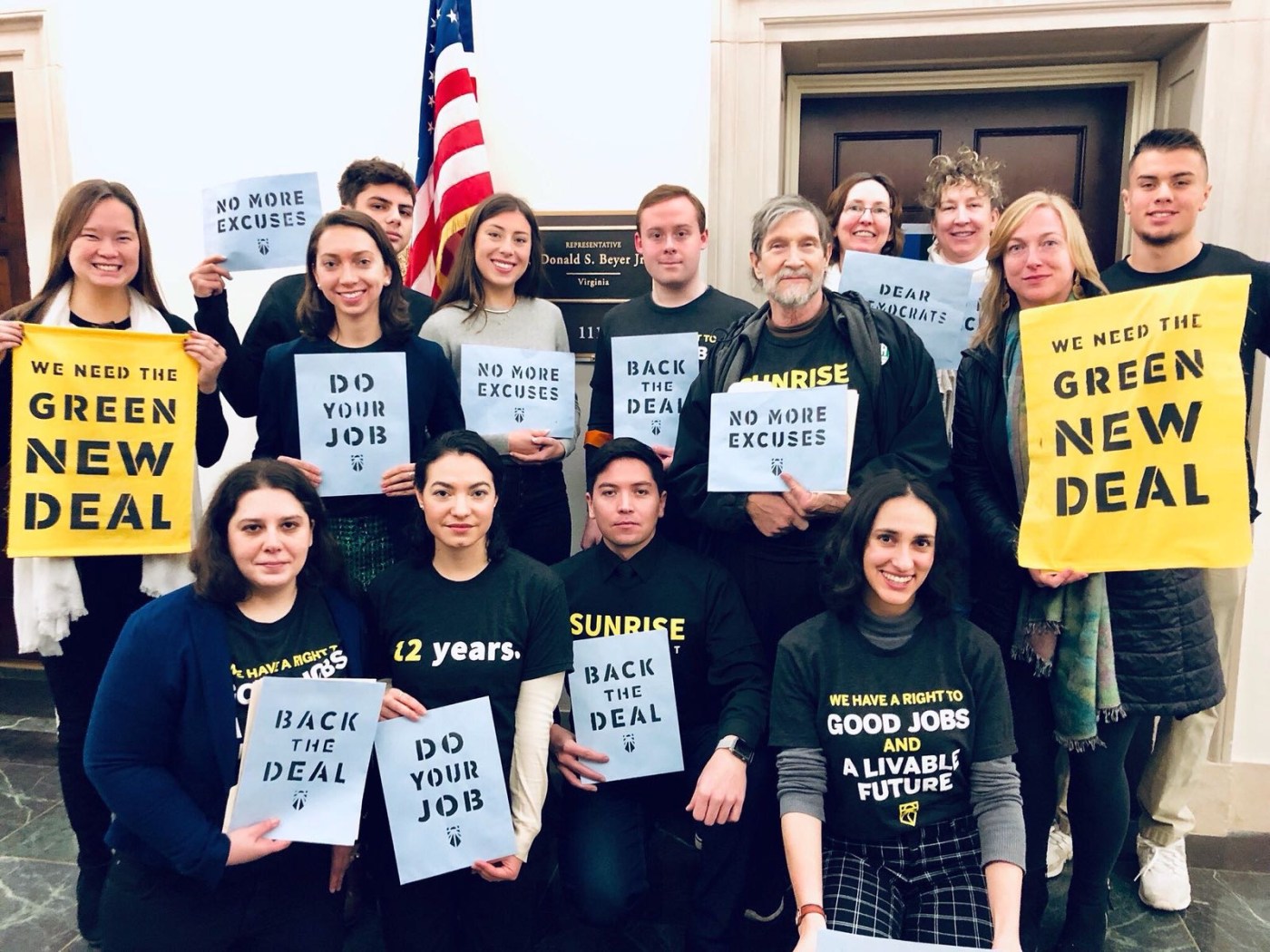
In light of this, the scale of the work that I will be doing in my role as a Community Environmental Conservation volunteer inspired in me a pre-emptive sense of restlessness. Will I be content turning used plastic bottles into flower arrangement crafts or organizing a community tree planting when I know that the fossil fuel industry is spending $350,000/day lobbying congress? Will I be able to share my passion for the integrity of creation with Panamanian students while knowing that the two years of my service are perhaps the two most precious years of political action in the U.S.’s climate movement? My experience of these tensions was heightened when in November, the climate movement erupted around a “Green New Deal,” opening previously unimaginable political possibilities for climate action. With the window for building renewable infrastructure rapidly shrinking and the newly-flipped house of representatives drafting policy that will shape what our planet looks like in 50 years, the moment felt urgent, existential, even. I was swept up with passion, feverishly writing letters to the editor, fundraising for the fast-growing Sunrise Movement, and attending my first-ever congressional lobbying day. I explored professional opportunities in the movement and even applied for a job in Boston. During my fall internship at The Democracy Collaborative, I watched the bustle of downtown D.C. from my 12th floor window; the coffee shops, cars, and cranes a familiar drama set to the soundtrack of my colleagues’ banter about public banking and green infrastructure. I asked myself, do I really want to forfeit my place in this work to serve in rural Central America? Despite the fact that I didn’t yet have a job or specific role in the U.S., it somehow felt irresponsible to leave in light of all of the buzz, and how much truly was at stake. There were a few weeks in November when I was almost certain I would remain in the U.S. to work on climate action.
Staying, however, did feel a liiiiittle short-sighted. Occasionally, I was able to tune into the slower, deeper current that persisted beneath the waves of emotions and noise—both of my own restless mind and of leftist Twitter (!)—to rediscover the force that had led me to pursue Peace Corps service in the first place. While quieted, my intentions remained unrocked by the storm erupting on the surface. I remembered the why: I want to grow in new ways by living in a culture that is different from my own and working with people who may think and act differently than I do. I want to become fluent in Spanish so that I can engage Spanish-speaking communities at home and abroad, becoming a more effective and inclusive organizer. I want to rekindle my personal connection to the natural world in ways that can strengthen and animate me for a lifetime of work on these issues. I want to learn what is to be learned in the space that opens up when we shed the comforts and conveniences of home. I also want to come to know the God who lives in that space.
I think that these are worthy things. There is a solid case to be made for why doing the Peace Corps is a far cry from an escape from the responsibility that I feel to act on climate change, as I sometimes fear. My concerns about this being a time of selfishness and personal investment can easily be countered by the realization that these next two years can be an opportunity for new growth in unanticipated directions that could ultimately benefit others as much as myself. I also remain profoundly inspired and strengthened by the examples of the people I know and love who have pursued service and immersion experiences, at home and abroad. The people who I most admire and aspire to be like have been drawn to and shaped by these sorts of experiences. Maybe there is something to be discovered there.
Implicit in ALL of this back-and-forth is my aforementioned giant-a** ego, which seems to be under the impression that I, at 23, am not only responsible, but capable, of altering the course of human-induced climate change (!). We’ll table that for now, lol, but want to acknowledge that these concerns are all dramatic, slightly trivial and objectively self-centered, and yet, they weighed heavily on me this winter and so I don’t want to overlook that as I sit on the other side.
After a few more weeks of thinking and doubting, and listening to more than a few wise and trusted voices, I have decided to pursue Peace Corps service after all. I realized—with the consolation of a few friends—that the moment of absolute certainty may never come. Furthermore, there is no “right” choice out there, waiting to be uncovered after a few more pros-cons tables (a stack of which remains stuffed in my desk drawer), frantic Facetime calls (you know who you are) or Reddit forums (a black hole, don’t go there). I describe my own scattered thought process in detail not because anyone asked for a play-by-play (except maybe Grandma! Hi!), but rather, to affirm that the paths that lead to our decisions are winding and the decisions themselves do not always provide clarity. I am just as unsure about everything that lies ahead as I was a year ago. Scratch that–I am more unsure. I am just a little more okay with what it feels like to sit in that uncertainty, “in suspense and incomplete,” as a line from one of my favorite prayers goes.
If I had say, however, why the scales ultimately tipped towards Peace Corps, I might point to a quote that I discovered this fall, as I spun on my swivel chair on the 12th floor at Dupont Circle. It is by American political activist Medea Benjamin:
The need for Americans and all people to think and act beyond our borders has never been greater. Transnational learning is essential to mobilizing for a just, livable future. Only at the global level can we address the voracious capitalist system that has led to multiple ecological, economic, and social crises. As global citizens, we need to demand systemic change commensurate with the systemic crises that afflict the lives of billions of people and the well-being of the global biosphere. To do this, we must monitor and learn from the successes and failures beyond our border. The issues at the heart of the US progressive movement are faced globally by all concerned citizens. Contact with people abroad, both inside and outside of government, is a source of both inspiration and ideas for affecting change, perhaps now especially at home. It is time for us Americans to take greater responsibility for the global future, to grasp how the actions of our government and corporations affect the world, and to mobilize to redirect the global trajectory from violence, war, and environmental chaos toward a sustainable, equitable, and thriving future.
I am doing Peace Corps not in spite of, but because of, the questions. I want to serve because I want to engage the tensions and the ties between the world that I am leaving behind and the world that I am about to encounter. I hope to do this through my service and in this space. This is why I have titled this blog as I have:
The U.N.’s IPCC tells us that we must limit the global warming caused by climate change to 1.5 degrees Celsius if we are to prevent the most catastrophic climate impacts. This is a reality that connects us all–through the fear that comes from living on a planet that is dying and the possibility of building future better than the one we’re headed towards. The Earth is, after all, what we all have in common.
Maybe the places I felt torn between—The United States and Panama—are not as separate as they seem. Maybe there are only a few degrees of separation between the two.
I’m not yet sure what shape this platform will take, or what its focus will be, but hope that if anything its title can serve as a personal reminder of our “one point five degree,” reality; a challenge for me to keep sight of the big, beautiful whole as I embark on this next chapter.
Thank you for reading. More to come.
~MTK
 onepointfivedegrees
Have almost as much love and admiration for your writing as I do for you. Can’t wait for more! Sitting in uncertainty and solidarity right alongside you,
Katie
LikeLike