The alarm goes off. I really don’t want to get up. At home, it was that I didn’t want to run. I didn’t want to feel the physical discomfort of exercise so early in the morning. Here, I don’t want to face the day. Yet. I don’t want to start. Getting out of bed means being seen, smiling, watching. Being watched. Being vulnerable to the whims of the day, whoever I might encounter and where they might take me. Here, I am safe. Alone, with the hum of the fan and the staccato of the chickens and the dogs. Some days their sounds annoy me, reminding me of why I want to stay in bed.
I sit up. Reach for my glasses. Check my phone. No signal in the house, so no new messages. I look at what was sent yesterday, to further delay. It’s 5:50. I should start moving. For some reason I only run at this time, even though I could probably go at 6:30, 7:30. It wouldn’t be too hot yet. This hour, however, feels more secret, more peaceful.
I rotate my body and dangle my feet off of the bed, watching them land on the floor. I think, We don’t have to be here. We get to be alive. This day is a gift. For some reason, I’ve started thinking this before my feet hit the floor. The idea of “we get to be here” a thought from some talk or book–I like it.
I take a swig from my water bottle, on the floor beside my bed. I strip my sports bra and shorts from my body, soft from my night sweat, and put on others. Socks, sneakers, I tuck my dirty hair into my purple Holy Cross hat.
My host parents are already up in the kitchen; the urgent narration of the morning noticias (news), oil sizzling and things being chopped for later. I sneak to the bathroom and exhale. I didn’t realize I had to pee so badly. Funny, I never see my host family use the bathroom. Maybe I drink too much water. I wash my hands and splash the excess on my face, my eyes lingering towards the mirror. I don’t look too long; it’s also too early to see my face—my acne scars, my tired eyes.
I unlock the front door—they know I’m up—and cross the yard to where there is an opening in the fence. My host family’s dog, Brandon, stirs, and begins to follow me. He accompanies me on my runs each morning; “El perro me sigue!” I explain. l look up the street, towards the school, and begin to shuffle my feet. I look up at the sky, to see what kind of day it is going to be. It’s pretty–the palm trees against the morning sky. Some days this part sparkles with the promise of the new day. Some days it carries a quiet, cloudy mist. I like those days the best.
I move up the street.
Ok, here we are. We’re doing it. I always have this thought right here. Every day right when I wake up I am convinced that I won’t be able to convince myself to run, and then I somehow arrive here. I am grateful. I am amazed.
At the top of the street, at the school, my phone connects to the WiFi, and messages roll in from overnight. My mom, a thread of memes from a Peace Corps group chat, an audio message from a friend. Someone liked something on a photo stream. The NY Times morning briefing. I round the turn.
The road begins to incline, giving way to portrero (pasture) on both sides. I am spooked by a cow grazing on the other side of the wire that lines the road. This is my favorite part. The sun hasn’t quite risen, I have yet to see another person.
At the top of the incline, I look out over the portrero, todo verdecito now that the rains have come. When I first arrived, my host dad leaned out the window of his little red beat up car and placed his finger to his eye. “Mira,” he said, pointing to the dusty expanse, “in a few months, you won’t recognize this view.”
It’s true. Now, everything is green.
I am still alone. Some days I don’t make it this far without seeing someone. I stride downhill for a bit, the asphalt carpeted with leaves and pods from a tree whose name I don’t yet know, and the occasional squished sapo (frog). “Como panqueques,” I sometimes joke with the kids.
At the bottom, the houses begin again. I hear the hum of a truck behind me, and I feel my body tense up. I inhale, waiting to see if it’s someone I know, if they’re going to stop. I trot to the side of the road. It’s a big red truck with men I know from my community riding in the back.
“Ouuueeeeeeeeeeee” they shout, the traditional gritar of the Azuero region.
“Bueeeeenas,” I smile and wave.
Sometimes it’s the Venezolanos who come each morning to pick up the fresh milk from arriba. They buy the milk and make cheese, my neighbors told me. Sometimes it’s the dad of one of my students, who leaves every day at 5:45 to work as a teacher in Chitre. Sometimes it’s my host dad, giving someone a ride to the entrada (entrance) or leaving early to sell lotería (lottery) or to look for a part somewhere.
I continue, passing the first houses with no signs of their inhabitants. They are probably up, however, making their tortilla or washing their clothes or watching the news. This is the part where I have to begin watching for the dogs. Brandon has followed me from our house, his company keeping the ones who are bravo at bay. The people in this part have milking machines, and I hear their hum, the rustle of the cows chewing.
I pass my community guide’s house, his dad’s house, his sister’s house. I pass a man who appears much younger than his age, carrying a machete and talking to himself. “Tiene que cuidar a los niños,” a woman told me a few days ago. “Look at him, how he does whatever he wants.” I nodded. I often wonder which moments should be teaching moments. I decided to let this one be; “We’re all a little different.” Today, I say buenas, even though I know he won’t respond.
I pass a semi-circle of houses where they make guarapo (sugar cane juice), and remember the day I spent making miel (sugar honey) with my community guide before the rains came. You can’t moler guarapo once the rains come because the caña (sugar cane) is too full of water. We used a horse to turn the metal gears of an old machine, wringing the golden juice out of the long palos (reeds). We stirred the juice for eight hours over a hot fogón (wood fired stove) until it turned thick, drizzling the honey onto a sheet of rusted metal and licking it off with our fingers. I smell the sickly, earthy sweetness of the miel at different points on my run, unsure if someone’s cooking honey or if it’s in the earth, in the breeze.
I arrive at the puente (bridge), a community landmark. “Dónde vive?” I ask people. “Después del puente.” “Al lado del puente.” Its mosaic of metal plates prompt a predictable series of noises every time a car crosses. Like a guard dog. The woman whose house I just passed lost her son on this puente; “El río le llevó.” A few different people have been killed crossing the puentes in my community, the river turned peligroso (dangerous) in the winter rains.
My own stride makes a lighter rick-a-tick-a-tat as I cross, followed by another, as Brandon crosses anxiously behind me. One day I crossed this puente with my guide’s dad, in a carreta, or ox-drawn carriage, and upon crossing, the cows sharply veered to one side, their gait turned nervous and awkward. “Porque lo hacen eso?” I asked. Why do they do this? “They’re scared,” he told me. I wonder if they can feel that there is no earth beneath them, if they, too, are terrified of being in suspense.
On the other side, I see another man cross the quebrada (river) on horseback, en route to sembrar caña (sew sugar cane). Like many people, I don’t know his name, but we’re friends. We greet each other, and I’m unsure whether to keep running or walk alongside him as we talk. Horse etiquette is awkward–they don’t teach you these things. I wave to another woman resting in a hammock on her front porch. I play basketball at the cancha (court) with her son sometimes. He has a soft voice, and soft eyes, and is training to be a police officer. Something buzzes at my feet. It’s a herd of flies, eating the mangoes rotting on the roadside. At the top of the road, I reach a cruce where I take one of three forks, depending on whether there are dogs; these ones can be less friendly. Sometimes, I trot by unnoticed, sacrificing Brandon to their sniffs and growls.
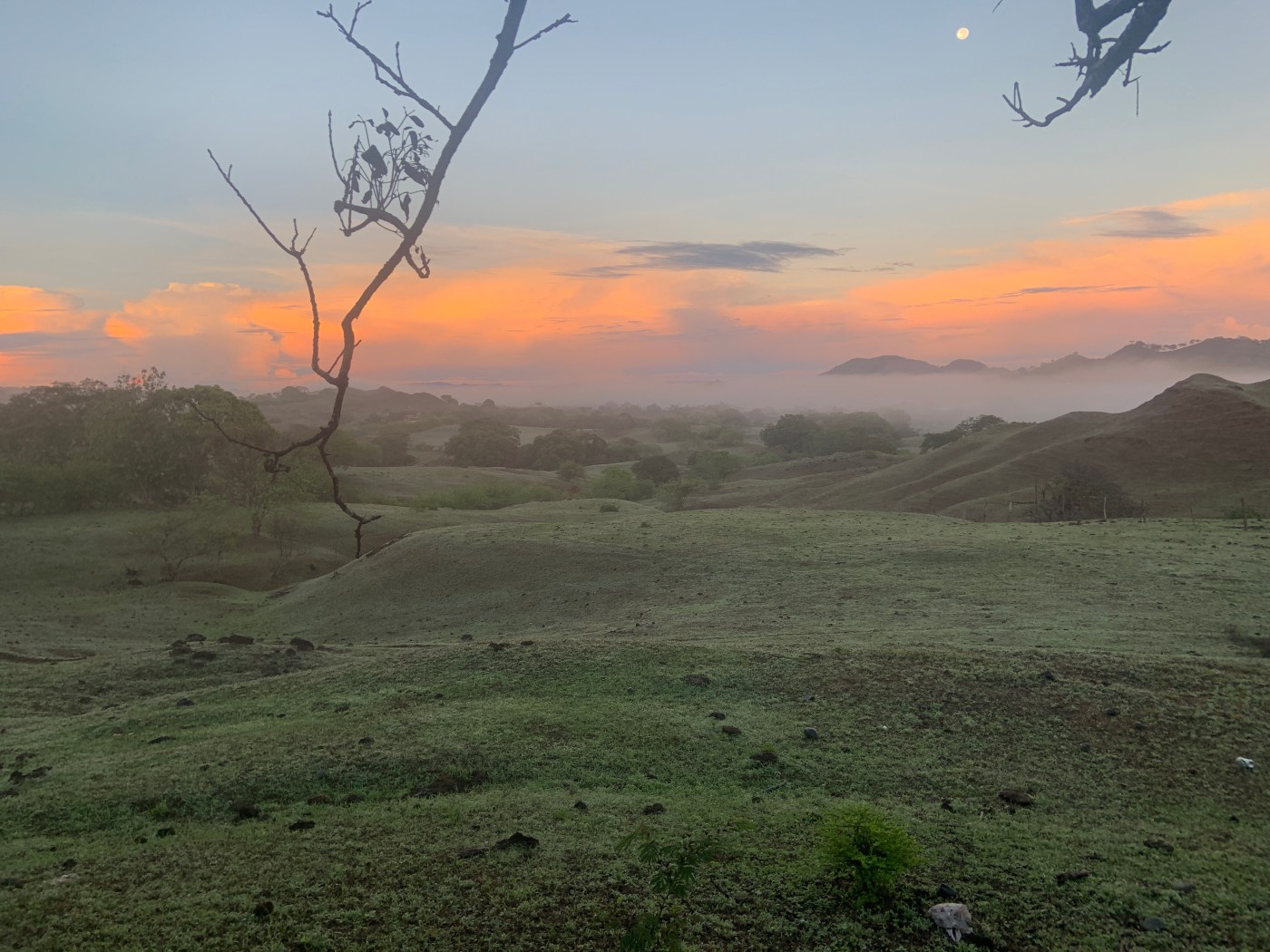
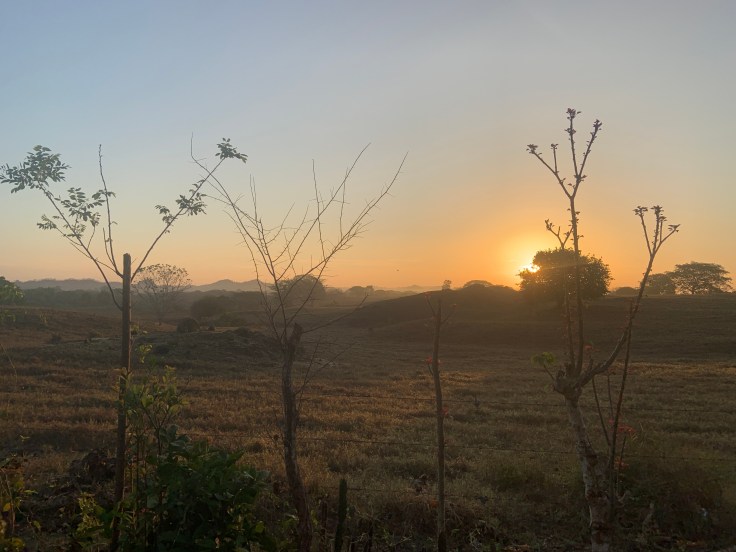
I take the far right path. To my left there is nothing but fields, the morning mist, some of the prettiest sunrise views in my site.
To the right there is a series of cinder-block houses arranged between palm trees; some of the more modest in my community. One of my student’s dads is brushing her hair in her front yard. “Bueeeeenas. Nos vemos pronto!”
I run to where the houses stop, and arrive at a herd of cows–these ones are milked by hand. This is where I turn around.
The way back I am focused. The tape plays in reverse–everything a little faster, blurrier. Trees, houses, dogs, mangoes, puente, cars. More people have woken up. They are moving the milk into the trucks now, the students are getting buttoned into their blue and white and uniforms, eating their pan. Thoughts about the day begin to creep in. I’ll shower off quickly, maybe do a few yoga poses. Eat my tortilla, arrive at the school.
I have to scale one hill, then another–a larger one–to arrive back arriba.
I always think that I’m going to have to walk the second one, self-destructively recalling the early hour, all of the rice I ate yesterday. But then I arrive at the top, blinking, unsure how I got there.
Sometimes, as I’m climbing the hill, I have the thought, “You’re doing it.” It. The thing. Running up the hill.
It, the thing. The Peace Corps.
“I am a Peace Corps Volunteer,” my cohort and I recited together at swear-in.
I’m four months in. I’m doing it.
I round the turn and slow to a stride, the gravel crunching beneath my uneven gait. I’ve arrived back at the school.
Most days they are already there, in their uniforms, hanging onto the fence or huddled in circles in the wet grass. Each one bien peinado, the little girls’ ponytails and braids carefully tied up in ribbons and clips. Behind them, the madres are mopping the tile out front, washing away the dirt from last night’s rain.
The morning mist. The sparkly promise.
I look up and see the clouds have yet to clear, holding back the sun with all their strength, the light of later buried in their bellies.
 onepointfivedegrees
wow!!! this belongs in the new york times!
LikeLike
“The Light of Later” … your phrase makes my day. Life’s surprises along our way. Thinking of you, M-T!
LikeLike
You should definitely compile your posts as a book on life in today’s Peace Corps upon your return to the US! You are a superb observer and writer. Tia Paula
LikeLike